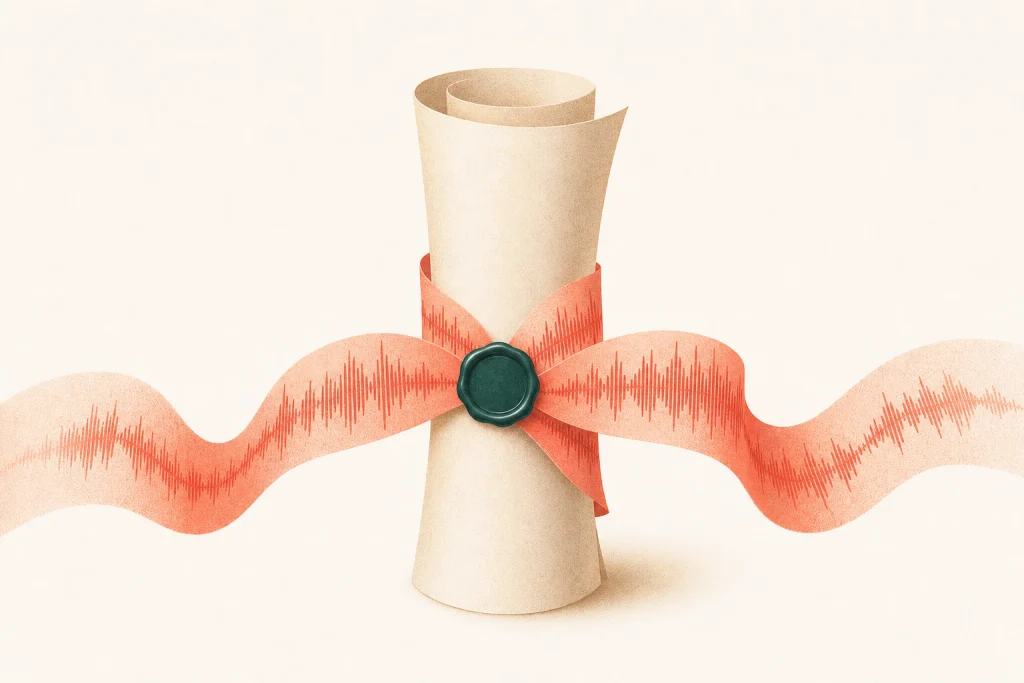
You own what you make here
No meter renting you your own audio, no watermark, no clause that quietly keeps your work.
Last updated June 10, 2026
The meter is the message
Most voice platforms price by the character. Every sentence you generate ticks a counter, and the counter is always somewhere on the screen. It sounds neutral. It is not. A per-character meter teaches you to ration your own ideas: shorten the chapter, skip the retake, settle for take two because take five costs money.
Creators feel this as a low hum of anxiety, and it changes the work. The whole point of generating voice is iteration, trying a line six ways until it lands. A meter that charges for every attempt punishes exactly the behavior that makes the output good.
Pricing is only half of it. The same platforms often layer on watermarks, attribution requirements, or tiers where commercial rights are an upsell. Add it up and a strange picture forms: you did the writing, you directed the read, and yet the audio somehow is not quite yours.
Ownership, in practice
Our stance fits in one sentence: you own what you make here. Because that sentence gets abused across this industry, here is what it means concretely, in the same plain language we use on the ownership page:
A license shaped like a receipt
Rights usually live in a terms-of-service document that nobody reads until something goes wrong. We think a license should read like a receipt instead: a handful of plain rows, issued with the work itself, answering the questions a creator actually asks. Can I sell this? Do I have to credit anyone? What happens if I cancel?
That is how we present it on the ownership page: commercial use, attribution, exports, watermark, territory, privacy, each with a one-word answer where one word is the truth. One honest footnote belongs here. We route to several engines, and the engine vendors set their own underlying license text. The per-engine summaries are published openly, and where a summary and a vendor term ever disagree, the vendor term governs that engine's output. Two of our engines are Apache-2.0 open-weight models, which makes their answer especially simple.
Why a flat allowance
Ownership and pricing are the same stance wearing different clothes. So instead of a per-character price, our plans are a flat monthly allowance. The unit is characters because that is what an engine consumes, but the translation is easy to hold in your head: about 1,000 characters is roughly a minute of speech. About, not exactly; we will not fake precision the engines do not have.
Inside your allowance, iteration is free in the way that matters: take five costs the same as take two, a retake never feels like a purchase, and your bill does not spike because chapter twelve ran long. The fast draft engine is not metered at all, so experimenting is genuinely without cost. You think in minutes and chapters. The meter stops being a character in your creative life.
A flat allowance also keeps our incentives pointed the right way. A platform paid per character earns more when you generate wastefully; a platform on a flat plan earns your renewal only if the work goes well. We would rather be paid for the second thing.
We are early, and the stance is the point
Honesty requires saying this part too: we are early. The product is live and real, the engine roster is still growing, and some pieces, like voice cloning, are still coming soon rather than shipped. We would rather tell you that here than have you discover it mid-project.
But the ownership stance is not a feature we will tune later. It is the foundation the rest is being built on, and it is deliberately expensive to walk back: every export is a plain file on your machine that no policy change of ours can reach. That is by design. The work is yours, and it stays yours even if we change, raise prices, or disappear.
If that stance matters to you, the best way to test it is to make something. The studio is free to start, and the first file you export will already be yours.
Check our work, then make your own.
The benchmark is live and the studio is free to start. Every claim above is one click from its source.