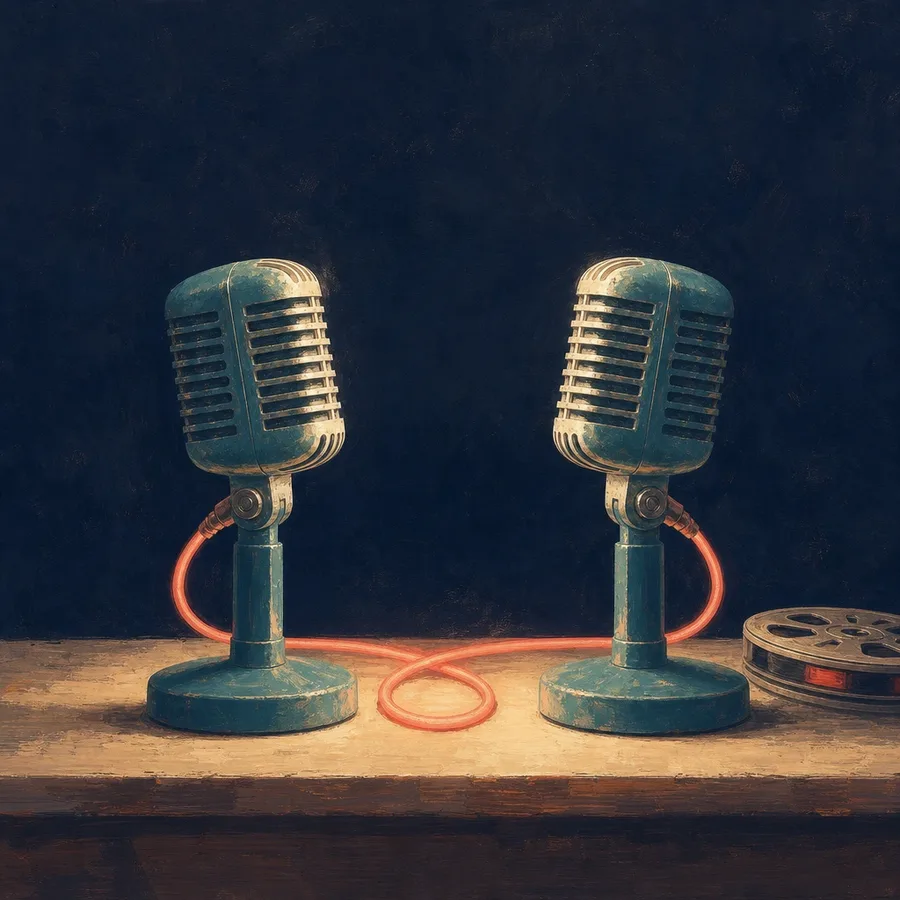
We built voice cloning. Then we didn't ship it.
The feature is built and flag-gated off. Doing it honestly is harder than building it, so we did the building and waited.
Last updated June 16, 2026
We built it, and left it switched off
Voice cloning is built. The code that turns a short recording into a reusable voice exists in this product today, behind a single flag, and we launched with that flag off. Every competitor we admire ships cloning loudly, often as the headline feature, so turning ours off for launch needs an explanation. Here it is.
The short version: building voice cloning is an engineering problem, and doing it honestly is a consent problem, and the second one is harder than the first. We would rather ship it late and right than on time and half-honest. So the studio launched with text to speech, transcription, dubbing, an audiobook studio, and AI music all live, and cloning marked coming soon rather than quietly enabled.
A cloned voice is not a recording
Cloning feels like recording, but the law treats it as something heavier. A modern cloning model does not keep your audio file; it derives a mathematical fingerprint of your voice, the timbre, pitch, and rhythm that make you recognizably you. Illinois calls that a voiceprint, and under its Biometric Information Privacy Act a voiceprint is biometric data, the same legal category as a fingerprint or a face scan.
That one classification changes everything downstream. BIPA is the strictest law of its kind because it lets people sue directly, with statutory damages per violation, and it has held up in court. A voiceprint built without proper notice and written consent is not a risk you paper over later; it is a cause of action the moment it exists. We did not want our first month to run on data we could not stand behind.
The full legal picture, in plain language, is in voice cloning consent and the law.
Consent is actually three different yeses
The reason a checkbox is not enough is that cloning a voice can require permission under three separate bodies of law at once, and each asks a different question.
- Biometric consent. If a voiceprint is created, biometric-privacy law (Illinois BIPA, and similar statutes in Texas and Washington) wants informed, written consent before it exists, plus a published schedule for deleting it.
- Right-of-publicity consent. A voice is part of a person's identity, so cloning someone's voice can also need their permission as a matter of likeness law. Tennessee's ELVIS Act made that explicit for AI voices in 2024, and even reaches the tools that enable unauthorized clones; California (AB 1836 and AB 2602) and New York (Section 50-f) added digital-replica protections of their own.
- Sector consent. Use a cloned voice in a phone call and the FCC's 2024 ruling drops you into the robocall rules; use one in political messaging and you meet a patchwork of state deepfake laws. The voice being yours to clone does not settle whether the use is allowed.
Why 'move fast' gets this exactly wrong
The standard cloning flow is one attestation box: I have the right to clone this voice. It is fast, it shifts all the risk onto the user, and it skips the part that actually matters, which is whether the person whose voice it is said yes.
Two facts make that box thin. First, the most-cloned voices, public figures and the dead, are the most legally protected, not the least, which is the opposite of how most people assume it works. Second, the harm here is not abstract: cloned-voice scams aimed at families reached the point of congressional testimony, and the federal NO FAKES Act, which would create a national right in your own voice, is moving through Congress precisely because the patchwork has gaps. A single self-certification is not the same as consent, and we did not want to launch pretending it was.
The deeper read, including where parody and public figures actually stand, is in cloning public figures and voice cloning scams.
What we will require before it ships
Deferring is not abandoning. Cloning is on the roadmap, and when it ships it ships with the consent machinery built in, not bolted on. The shape is already decided:
- Separate the two yeses. Consent that this is your own voice is one thing; authorization to clone someone else's voice is a different thing, and the flow will ask for them separately rather than rolling both into one box.
- Real consent records. Informed, written consent captured before any voiceprint is created, a stored receipt, and deletion that actually reaches the engine, not just our database.
- Hard lines that do not flex. No cloning of minors, ever; no public-figure or deceased-voice clones without verified authorization; a victim-takedown path that works.
- Disclosure that travels with the audio. Cloned output is labeled as AI-generated, which is its own story.
Coming soon, said honestly
It would have been easy to flip the flag and launch with a cloning headline. The reason we did not is the same reason the rest of this blog exists: we would rather you trust the arithmetic and the disclosures than our marketing. A feature that handles your biometric identity is the last place to cut that corner.
So cloning waits until the consent flow is as finished as the engine, and until we open the markets where the cloning laws fully apply. When it lands, it lands here first, with the same plain account of what it does and does not do. Until then, the rest of the studio is live, and what you make in it is already yours to keep. And if the reason you are looking for a new voice tool is that the last one turned your industry away, that door is open here too.
Check our work, then make your own.
The benchmark is live and the studio is free to start. Every claim above is one click from its source.