
Lawful, not lawless: the industries every other AI voice tool turns away
We do not deplatform lawful businesses by industry or viewpoint. Who refuses firearms, cannabis, crypto, and gambling, with the receipts, and the voice tooling they are pushed to need.
Last updated June 27, 2026
The line nobody wants to draw out loud
In one week last spring, a single FFL-holding gun shop in a state where every sale it makes is legal got three different answers that all meant no. An AI writing tool refused to draft its product descriptions. A payment processor put a hold on its account pending "review." An ad network disapproved its campaign and warned that one more try could cost it the account. None of those answers pointed to anything the shop had done. The shop had broken no law, lost no case, harmed no customer. It was told no for what it sells, not for anything it did. A state-licensed dispensary two states over had the same week. So did a registered FX broker. Same pattern, different glyph on the door.
That is the reality this post is about, and here is where we stand on it, stated plainly so the rest of the post can be held against it: we do not deplatform lawful businesses by industry or by viewpoint. If your work is legal, you are welcome here, whether you sell firearms, cannabis, supplements, crypto, sports betting, or vaping. That is a narrow, specific promise, and it is the opposite of "anything goes." We keep an Acceptable Use Policy, and it is strict: no illegal content, no fraud or deception, no impersonating real people without consent, no threats or incitement, no sexual content involving minors, no non-consensual sexual content, no IP theft. Read it; it is short and public.
The line we draw is the one the big platforms refuse to draw. They ban whole lawful industries by category. We ban unlawful conduct, by anyone, in any industry. Those are not the same line, and the difference is the entire point of this post. If you came here looking for an AI voice generator or text to speech for regulated industries that will not refuse you on sight, that distinction is the whole answer.
We are going to do this the way we do everything on this blog: name the industries plainly, show exactly who refuses them and quote the policy that does it, then map our actual tools to what each industry can lawfully do with audio. We would rather show receipts than slogans. It is the same instinct behind our open benchmark, where we publish scores even when our own engines lose. Trust the arithmetic, not the marketing. This post is the arithmetic of who gets shut out, and what an ai voice generator can honestly do about it.
A standing note before the receipts begin: every third-party policy quoted below is that platform's own published policy as we read it as of June 2026. Policies change, sometimes quietly, so treat each one as dated rather than permanent, and verify the current text on the platform's own page before you rely on it. We would rather you check than take our word.
This is a long read on purpose. If you came for your own vertical, jump straight to it:
Four gatekeepers, one pattern
The refusal does not come from one place. It comes from four layers, stacked, and a business usually meets all of them. Once you see the layers, the pattern is hard to unsee.
A note on how we name these companies: we name them and quote their published policies for comparison and verification, their marks belong to them, and nothing here implies affiliation or endorsement.
AI tools and voice vendors. OpenAI's Usage Policies, as published and as of June 2026, flatly prohibit using its tools for "real money gambling," for "develop or use weapons" (the wording in its current unified Usage Policies effective October 29, 2025), and they restrict political campaigning and lobbying, all of it jurisdiction-blind: legal or not where you operate makes no difference to the policy text. ElevenLabs, a direct AI-voice competitor and one of the names you will compare us against, is cleaner still as a proof point. Its own published Prohibited Use Policy, as of June 2026, bars facilitation of firearms and explosive weapons, bars real-money gambling and payday lending, and bars the marketing of tobacco, controlled substances, supplements, and herbal remedies without prior written authorization, while restricting crypto-trading advice. That is a single AI-voice vendor, in its own published terms, ruling out most of the industries in this post. If you searched "elevenlabs alternative" and landed here, this paragraph is why. (Read its current policy yourself before you rely on this; a competitor's terms are exactly the kind of thing that gets revised.)
The payment rails under the voice vendors compound it. Even a willing voice vendor sits on top of a merchant-of-record or processor that has its own bans. Paddle, a common merchant-of-record for software, prohibits adult, gambling, and political campaigning in its published acceptable-use terms as of June 2026, and specifically names deepfake, voice-impersonation, and likeness-without-consent merchants. Helcim, per its published terms as of June 2026, bans firearms, weapons, explosives, and gambling outright. So a vendor can welcome you at the front door and still be unable to bill you at the back.
Payment processors directly. Stripe, in its published restricted-businesses list as of June 2026, prohibits adult content (including AI-generated sexual content), restricts gambling, crypto, supplements, and vaping, and lists firearms as restricted (limited availability, contact their sales team); on cannabis it prohibits marijuana and THC-bearing CBD while treating low- or no-THC hemp CBD as restricted. PayPal's published acceptable-use policy (as of June 2026) bans firearms and ammunition outright. Square's published terms (as of June 2026) restrict hemp-CBD to its conditional CBD program and ban kratom and tobacco/vape products, and have frozen merchant funds on detection. These are not edge cases dredged up to make a point; they are the front pages of these companies' own acceptable-use lists, on the dates we read them.
Ad networks. This is the layer that pushes these businesses off paid acquisition entirely. Meta and Google ban ads for firearms and ammunition and for tobacco and vaping, and gate gambling and several regulated categories (with crypto, CBD, or supplements gated on some platforms) behind certification, geography, and age limits, with disapprovals that escalate to account suspension. TikTok's published ad policies are restrictive on several of these too. For a lawful business, the paid-ads lane is simply closed or barely ajar.
Banks and card networks. The documented cases are not theory. Operation Choke Point pressured banks away from lawful-but-disfavored merchants in the 2010s, and the 2023 to 2025 "Choke Point 2.0" debate centered on crypto firms losing bank accounts; both are documented in congressional reports (House Oversight 2014; House Financial Services debanking report 2025). Mastercard and Visa cut off a major adult platform in 2020; the well-documented adult-creator payment reversal in 2021 was driven by the same card-network pressure; Mastercard halted PIN-debit for cannabis purchases in 2023; the firearms merchant-category-code fight pitted card networks against retailers; and Shopify Payments, per its published terms as of June 2026, excludes most firearms sellers. Each of these is reported in the card networks' and platforms' own announcements and contemporaneous coverage; dates are given so you can pull the originals.
Lay the four layers side by side and the synthesis writes itself. Across all of them, the refusal is by industry and by viewpoint, not by any finding of illegality. No court ruled. No customer was harmed. The category itself is the offense. That is the pattern this whole post answers.

* Each cell is the platform's own published policy as of June 2026; restricted means allowed only with extra paperwork, certification, or geo limits, not freely. Verify before you rely.
Lawful is not lawless: where we actually draw the line
Here is the misread we want to head off before it starts: "so you're the uncensored one." No. That word signals NSFW or illegal intent, and it is the opposite of what we are. Our welcome is narrow and it is verifiable, and the way you verify it is by reading where we actually draw the line.
Nothing in our Acceptable Use Policy restricts firearms and 2A, cannabis and CBD, gambling and iGaming, crypto and web3, vaping, supplements and nutra, forex, or adult businesses by category. It restricts uses. The red lines are about conduct, and they are short enough to list in plain language: no illegal content; no fraud, deception, or voice-phishing; no impersonating a real, identifiable person without consent; no deceptive deepfakes; no threats, incitement, or hate; no sexual content involving minors; no non-consensual sexual content depicting a real person; no IP infringement; no audio you obtained unlawfully.
We say the consent and no-impersonation line with pride, not apology. It is the same red line OpenAI, ElevenLabs, and Paddle draw, and it protects the very people deepfakes target. Drawing that line clearly is exactly what lets us welcome everyone else without flinching. A label is not an apology, and a red line is not a hedge. It is the thing that makes the open door safe to walk through.
Enforcement is a ladder, and we will be honest about it: warning, content removal, suspension, termination, with CSAM reported as the law requires. We restrain ourselves precisely where the law tells us to. That same consent discipline is why we built voice cloning and chose not to ship it at launch: we are waiting until we can stand up real consent machinery for a feature that copies a real person's voice, not because cloning is unlawful, but because doing it responsibly takes biometric-grade consent we will not fake. Cloning is on the roadmap; the discipline is permanent, the deferral is not. Permissive about lawful industries, careful about consent and conduct, on purpose.
So here is the sentence the whole post turns on, and we will repeat it on purpose: we ban unlawful conduct by anyone; we do not ban lawful industries by category.
The honest caveat: one engine carries filters we don't control
We would rather you read this here than discover it mid-project. One of our five engines, Gemini Flash, carries Google's own safety classifiers. They operate at the model layer, they are not configurable by us, and they can refuse a lawful prompt regardless of how permissive our own stance is. We cannot turn them off, and we will not pretend they are not there.
The honest part is also the useful part, with one important boundary on it. For English text-to-speech, audiobook, and IVR work, engine choice is a real escape hatch: if Gemini Flash refuses a lawful firearms script or a cannabis education segment, switch to Kokoro, Grok Voice, MAI Voice 2, or Zonos, and your English read is not gated by Google's classifier. That four-engine fallback is full for English work.
It is only partial for multilingual and dubbing work, and we will not blur that. Gemini Flash is the only multilingual engine in our roster; the other four are English-only. So for dubbing and any non-English read, the Gemini filter sits in the path and the four-engine fallback does not apply: there is no English-only engine that can do a Spanish, Hindi, or Arabic dub instead. If a lawful multilingual prompt is refused by the classifier, the move is to revise the script at the editable text stage, not to switch engines, because there is no other multilingual engine to switch to. We say this plainly here, and we repeat it in the crypto, forex, and gambling sections where localization carries the weight, so nobody buys a redundancy we cannot deliver for non-English work.
There is a real tradeoff to state, not bury. Gemini Flash is the engine that genuinely acts bracketed cues like an emotion direction, and it is the multilingual engine in the roster, so it is often worth reaching for first. The other four are English-only plain-read engines that tell you up front they ignore cues. You give up the filtered engine's expressiveness when you route around it for English work, and you gain a read that is not subject to the filter that stopped you on Gemini. We do not promise those four engines never refuse or error on anything; they are third-party models, and we only claim the specific true thing, which is that they carry no Google safety layer. Pick per job. The full roster, with samples, is on the engines page so the claim is checkable, the same way our open benchmark is: we tell you the limitation before you hit it. The cue-versus-flat production split has its own post.

What these industries are actually worth
It would be easy to read all of this as a fight over fringe businesses. It is not. These are large, lawful, taxed industries that the big platforms decline to serve, and the numbers say so. We have rounded each figure to a defensible level and named its source and year, because false precision is its own kind of dishonesty.
Walk the headline figures, each with its source and year. The US firearm and ammunition industry's total economic impact was about $90B in 2024 (NSSF's annual economic-impact estimate, an industry-association figure). US legal cannabis sales were roughly $30B in 2024 (industry sales trackers). US online gambling broadly was about $14B in 2025 (Grand View Research); narrower iGaming-only estimates run lower. Dietary supplements are the giant here, but the size depends entirely on definition: 2025 estimates vary widely, from roughly $100B (Fortune Business Insights, dietary supplements) to over $400B for the broader nutraceuticals market, and supplements is a global figure while the other bars are US-scope, so we flag the scope difference rather than pretend they share a denominator. US e-cigarette and vape sales were about $8B to $10B (Statista put US e-cigarette revenue over $8B in 2023). US adult entertainment is commonly estimated in the low-to-mid teens of billions, though figures vary and lack strong primary sourcing, and we mention it once, in a single line, on purpose.
Two figures need a caveat in prose rather than a misleading bar on a shared chart. Crypto's total market capitalization was roughly $2.73T in 2025, but that is asset value, not industry revenue, so we cite it with that footnote and keep it off the same-scale chart. Forex is best described as about $9.6T per day in FX turnover (April 2025, BIS Triennial Survey), which is a daily-turnover figure, not an annual market size; treating it as one would be dishonest, so we flag it and leave it off the bars too.
Here is the bridge sentence, and it is the reason any of this connects to voice. Every one of these industries shares one structural fact: paid ads are banned or gated, so they live on owned media. Their own site, their YouTube channel, their podcast, their email list, their IVR phone tree, their internal training. That is precisely where voice and audio tooling earns its keep, and precisely the lane where we can help.
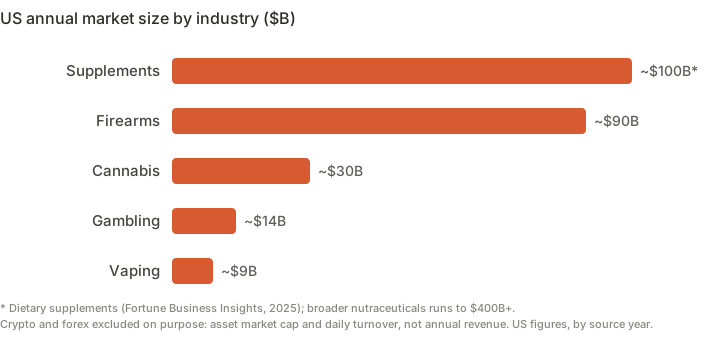
* Crypto is asset market cap, not industry revenue. Forex is daily turnover (BIS, April 2025), not an annual market. Supplements range varies by definition. Search data: DataForSEO, US.
The demand is already here, just in the wrong format
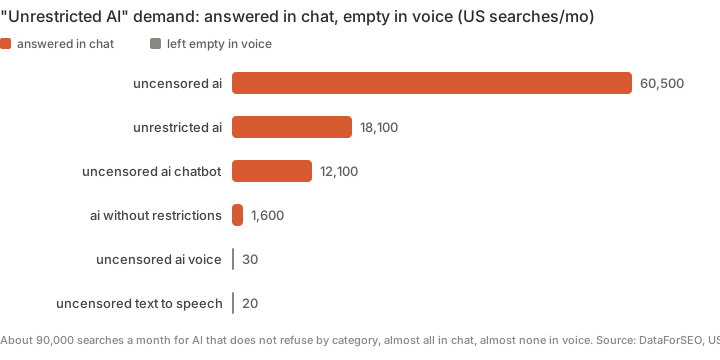
Now the part where the search data tells on the market. There is enormous demand for AI that does not refuse by category. Look at the US monthly search volumes: "uncensored ai" pulls 60,500, "unrestricted ai" 18,100, "uncensored ai chatbot" 12,100, "ai without restrictions" 1,600. That is roughly 90,000 searches a month, and growing.
Now look at the same demand in the voice vertical: "uncensored ai voice" gets 30 searches a month. "Uncensored text to speech" gets 20. Not thousands. Twenty and thirty.
The honest read is not that the need is fringe. It is that the need has been answered in chat, not in voice. Someone built unrestricted chat tools and the searches found them. Nobody built the voice equivalent, so the searches in voice never formed. The cliff between those two clusters is the whole opportunity, and it is the whole reason this page exists.
We want to be precise about what we are and are not doing with that demand, because the wording matters. We are not chasing the word "uncensored." We quote it here only as a search term we observe, never as a claim about what Cantari is, because the word signals NSFW and illegal intent and that contradicts both our product and our AUP. What we are answering is the lawful half of that demand: legitimate businesses that simply want text to speech and audio tooling that will not ban their industry. If you searched for an unrestricted voice tool and found nothing useful, that absence was not a verdict on your need. It was an empty vertical. We serve the lawful demand, we draw the line at unlawful conduct, and we are saying both in the same breath.

Firearms and 2A
Firearms businesses are pushed almost entirely onto owned media. Meta and Google ban the ads, YouTube demonetizes and age-restricts much of the content, and the payment and banking layers add their own friction. We will be straight with you: we cannot lift those ad bans. What we can do is serve the lane you are forced into, the owned-media lane, and serve it well. One thing we want stated outright, because it is the line our own payment rails care about too: Cantari does not facilitate the sale, transfer, or advertising-placement of firearms; we render the audio for your own lawful, owned channels.
Map the tools to the actual work, and notice that the work we lean on hardest is education, safety, compliance, and operations, not sales promotion. Audiobook Studio turns multi-location staff SOPs and your ATF and Form 4473 compliance manuals into clean, consistent audio that every store hears the same way. Text to Speech voices the educational safety and history content that does well on YouTube when it is informational rather than promotional, and narrates range-safety and handling guidance for your own site. Speech to Text transcribes range-safety briefings and training sessions into searchable records. IVR-style reads cover store hours, range bookings, and FFL-transfer status. Audio versions of range rules and handbooks make your operation more accessible. Where you do voice owned-media product information, keep it informational and on your own channels; we are not the lane for transactional sales placement, and the rest of the stack would not let us be.
For voices, this vertical wants crisp and credible. The Brief pack (Fenrir, low and gravelly, or Rex, assured and direct) suits clear informational reads. The Narrators (Michael, a steady American male, or Miles, an even American male) carry long-form compliance manuals and audiobooks without fatigue. When educational or historical content needs real delivery, the Performers, voiced through Gemini Flash with acted cues, give it the performance a flat read cannot.
The welcome is operational, not rhetorical: a lawful, licensed firearms business is welcome here, and the AUP bars only unlawful conduct (no facilitating illegal sales, no weapons-development instructions, the same red lines every serious platform draws). The terms the rest of the industry quietly underserves, "firearm marketing" and "gun store marketing," describe exactly this owned-media safety, education, and compliance work.
Cannabis and CBD
Cannabis may be the most ad-starved vertical of all. Google, Meta, and TikTok effectively lock it out, and even the payment and banking layers move against it, as Mastercard's 2023 PIN-debit halt showed. So the industry lives or dies on SEO, education, and owned media, which is the ideal home for audio at scale. We serve that owned-media lane; we cannot reopen the banned ad lane, and we will not pretend otherwise. One qualifier we will not skip: this welcome is for businesses operating where lawful in their own jurisdiction, and cannabis remains federally illegal in the US even where states have legalized it, so we do not imply federal legality and neither should your audio.
Map the tools. Text to Speech narrates cannabinoid, terpene, and dosage education libraries, the SEO engine that has to replace the ads you are not allowed to run, plus dynamic menu narration that updates as your inventory does. Audiobook Studio produces budtender training and multi-state SOP audiobooks you can keep current as the rules shift under you. Dubbing & Translation localizes menus and education for tourist-heavy markets (this runs on Gemini Flash, the one multilingual engine, so the Google filter is in the path for non-English work and the fix for a refusal is a script edit, not an engine switch). Speech to Text turns your education webinars into searchable transcripts that rank. IVR reads handle menu, hours, delivery, and ID questions.
For voice, cannabis education leans warm and welcoming. The Warm Range (Emma, a soft British female, or Ara, calm and friendly) fits wellness and education content. The Narrators carry the SOP audiobooks. The Brief handles crisp menu and product reads.
State-licensed cannabis and CBD businesses, where lawful in their jurisdiction, are welcome; the AUP draws its line at unlawful content, not at the plant. The work we are describing is what "dispensary marketing" actually means in practice, and "cannabis voice over" is a phrase almost nobody has built for. We have.
Crypto, web3, and online gambling
These two verticals are content-dense, multilingual, and compliance-heavy, so we will cover them together. Both are forced onto organic distribution, and both produce mountains of explanatory and disclosure audio whether they want to or not. One honest note up front, because both lean on localization: all multilingual and dubbing work runs on Gemini Flash, the only multilingual engine, so the Google classifier is in the path for non-English audio and the four-engine fallback covers only the English reads. If a lawful multilingual prompt is filtered, you revise the script, not the engine.
Crypto and web3. Paid acquisition is heavily restricted, so crypto leans on organic YouTube, SEO, and community. Dubbing & Translation localizes tutorials and onboarding at scale for LATAM, SEA, and MENA audiences, where much of the real growth is, on Gemini Flash. Text to Speech voices in-app risk and volatility disclosure audio and Academy lessons. Speech to Text transcribes AMAs, Spaces, and Discord town halls into multilingual update podcasts, and that same transcription QA can help you flag risky language like "guaranteed profit" before it ships. The owned-media terms here, "crypto marketing" and "nft marketing," carry some of the highest CPCs in this entire post, which tells you how starved the lane is.
Gambling and iGaming. This is content-dense and relentlessly compliance-heavy, and the cleanest, lowest-risk work is the compliance and training side, so we lead with it. Audiobook Studio handles responsible-gambling, AML, and KYC training that changes constantly and has to be re-recorded every time it does. Speech to Text turns betting shows and training sessions into searchable, auditable records, and IVR covers account, KYC, and withdrawal queries. Only after that does promotional audio come in as a secondary use: Text to Speech narrates how-to and explainer content (parlays, moneylines) and can produce state-versioned promo audio with localized legal disclaimers and the "21+, gambling problem call..." lines baked into the script you supply. Gambling ad rules vary sharply by state and country, so jurisdictional advertising compliance is yours to own (see the global responsibility note near the close).
Across both, the voices want credibility and reach. The Brief (Rex, assured and direct, or Leo, a bold projected read, or Zephyr, bright and energetic from the Gemini set) fits briefings and ad-style reads. The Performers through Gemini Flash, the one multilingual engine, carry the dubbing. The Narrators handle the long compliance training.
We will be explicit about the limit: we cannot change licensing rules or geo-gated ad policy. What we can do is power the disclosure, education, and localization these businesses must produce anyway. Both are welcome, and the AUP applies the same way to both: conduct, not category. The phrases that describe this work, "igaming marketing" and "sports betting marketing," are the owned-media lane these operators already live in.
Vaping, supplements, and forex
Three more verticals where the value is the same shape: standardized, pre-approved, disclosure-laden audio, produced at volume, kept current.
Vaping. Broadly banned from paid social and search. Text to Speech narrates your warning-inclusive script for age-gated device education, voices standardized safety-warning segments, and produces recall messaging that has to go out fast and identically everywhere. To be precise about what the tool does and does not do: we render the health warnings and disclaimers that are in the script you supply; we do not automatically detect, insert, or verify required warnings for you, so the compliant language has to be in your text before you generate. Dubbing & Translation handles retailer and distributor staff training per market (on Gemini Flash, the one multilingual engine). Speech to Text transcribes complaint and adverse-event calls into records you can act on. "Vape marketing" is, again, an owned-media problem, because the paid lane is shut.
Supplements and nutra. The giant in this post: 2025 estimates range from roughly $100B (Fortune Business Insights, dietary supplements) to over $400B for the broader nutraceuticals market, depending on how you draw the line, and it keeps climbing. Supplements *can* advertise, but every word is regulated, so the value here is compliant, pre-approved, standardized audio. Text to Speech generates narration from your pre-approved structure-function scripts ("supports joint health," not "treats arthritis") with the FDA disclaimer written into the voiceover script so it never gets dropped. To be clear about the division of labor: Cantari renders your pre-approved script; we do not provide regulatory review or approve claims, so the structure-function wording and the disclaimers are yours to clear before they reach us. Audiobook Studio handles cGMP and DSHEA training and long wellness guides. Speech to Text supports adverse-event monitoring. The Warm Range suits the wellness tone; Harper, the expressive MAI Voice 2 lead, carries the branded structure-function and ad-style reads where a warmer, performed delivery earns its keep; the Narrators carry the training. "Supplement marketing" is the search term; compliant narration at scale is the job.
Forex. Heavy disclosure obligations, intensely global. Text to Speech narrates standardized risk-disclosure and platform tutorials. Dubbing & Translation localizes all of that education for EMEA, APAC, and LATAM on Gemini Flash, the one multilingual engine, which means the Google filter is in the path for the non-English work and the four-engine fallback covers only the English reads. Speech to Text turns analyst webinars into multilingual briefings, and audio Key Information Documents make the disclosures accessible. The Brief carries the credible product and disclosure reads; the Narrators carry the long training. "Forex marketing" describes precisely this owned-media disclosure work.
For all three: lawful businesses in these verticals are welcome, and the AUP restricts conduct, not the category you operate in.
A careful word on adult businesses
Lawful adult businesses are deplatformed too, and the pattern is the same one this whole post describes: the major adult-platform card-network cutoff in 2020, the well-documented adult-creator payment reversal in 2021, the Stripe and PayPal bans. We acknowledge that honestly, and we keep our scope here deliberately narrow.
What we serve for lawful, consent-based, age-verified adult businesses is the business side, and only the non-explicit business side: customer-support IVR for billing and subscriptions, accessibility TTS and captioning of non-explicit informational pages, internal staff training on safety, consent, and data protection, and multilingual localization of help and legal-terms pages (localization runs on Gemini Flash, the one multilingual engine). In the same breath, the hard limits in our Acceptable Use Policy do not move: zero tolerance for sexual content involving minors, and no non-consensual sexual content depicting any real person. That is the bright line. It does not bend for any industry, and that is exactly why we can serve the rest of the industry's legitimate, non-explicit operational needs without hesitation.
Why a multi-engine studio is the right shape for this
Step back, and the product argument is really one argument: the welcome only works because of how the studio is built.
Multi-engine is the structural answer to one-vendor filters, for English work most of all. Five real engines (Gemini Flash, Kokoro, Grok Voice, MAI Voice 2, Zonos) mean no single vendor's classifier is a chokepoint on your English reads. If one engine refuses a lawful English prompt, four others are right there. For multilingual and dubbing work the honest picture is narrower: that runs on Gemini Flash alone, so the redundancy is real for English and partial for non-English, and we would rather say so than oversell it. The engines page shows all five, with samples. A single-engine tool cannot make even the English promise, because its one vendor's policy is the whole policy.
Ownership reinforces the welcome. You own what you make here: worldwide commercial rights, no watermark, MP3 and WAV files you keep. A deplatformed business has learned the hard way not to build on rented ground that can be pulled out from under it. The file you export survives any policy change, including ours.
Pricing removes the meter anxiety. A flat allowance, free to start, with unlimited Kokoro drafting on our pricing, means a business producing high volumes of compliance and education audio is not rationed by the minute. That matters more than it sounds when your entire distribution strategy has to be owned media, because owned media is a volume game.
And restraint is the credibility counterweight. We built voice cloning and chose not to ship it at launch, and the reason is consent discipline, not industry-strictness: cloning a real person's voice needs biometric-grade consent machinery we will not fake, so we are waiting until we can do it right rather than shipping it early. Cloning is on the roadmap; the consent standard behind the delay is the permanent part. That is the same discipline that lets us be permissive about lawful industries while staying strict about consent and conduct. The named competitors people reach for, Murf, Play.ht, ElevenLabs, all exclude most of the industries above in their published terms (as of June 2026; verify before you buy). Our use-cases (advertising, podcasts, youtube-video, product-demos, localization) are built for exactly the owned-media work these businesses are forced to live on.
Open the studio and judge it yourself
One last time, plainly, because it is the sentence everything here rests on: we do not deplatform lawful businesses by industry or viewpoint. We draw the line at unlawful conduct, not at lawful industries. The Acceptable Use Policy is short, public, and the receipt for that claim. Read it and hold us to it.
And the limits, in print, on brand: we are a solo-founder studio, US-only at launch, early, with a roster that is still growing, and one of our engines carries filters we do not control (and that engine is the only multilingual one, so the filter is unavoidable for dubbing work). We would rather you know all of that going in than find it out halfway through a project.
One responsibility line that applies across every industry above: Cantari renders the script you supply and does not review or approve it for legal or regulatory compliance; that responsibility is yours.
So do not take our word for it. Read the AUP. Browse the engines and hear them. Then put a lawful script from your own industry into Text to Speech, it runs without an account, and listen. That is the only way to know whether an AI voice generator will actually serve your industry.
When you want the full studio, audiobooks, dubbing, transcription, create a free account and it opens on the other side. The first file you export is already yours. Bring the script the other tools turned away.
Check our work, then make your own.
The benchmark is live and the studio is free to start. Every claim above is one click from its source.